
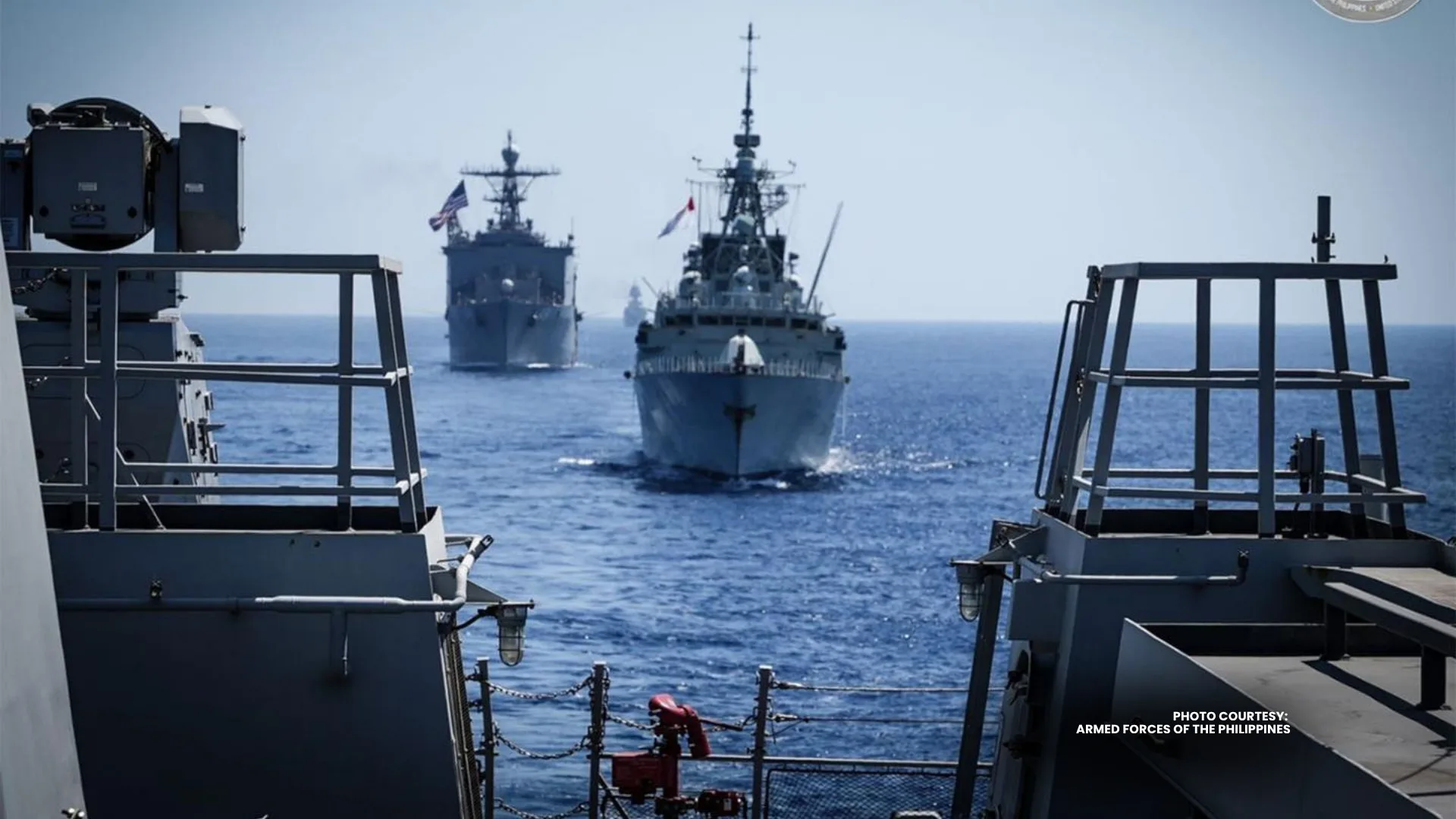
The Armed Forces of the Philippines (AFP) said Tuesday it did not monitor any dangerous or aggressive actions by Chinese forces during the recently concluded Balikatan military exercises in the West Philippine Sea, although Chinese vessels closely shadowed participating ships.
Rear Admiral Roy Vincent Trinidad, AFP spokesperson for the West Philippine Sea, said no coercive incidents were recorded throughout the multinational drills involving the Philippines, the United States, and several allied nations.
“During the conduct of Balikatan, there were no recorded coercive and aggressive actions,” Trinidad said during a press briefing at Camp Aguinaldo.
He said the military instead observed what appeared to be Chinese propaganda narratives claiming that Beijing was conducting its own combat exercises near Bajo de Masinloc, also known internationally as Scarborough Shoal.
China seized control of the disputed shoal in 2012 following a standoff with Philippine vessels and has since restricted Filipino fishermen from entering its lagoon.
According to Trinidad, the AFP monitored the presence of Chinese Navy ships, China Coast Guard vessels, maritime militia ships, and military aircraft in the area during the exercises.
Despite the deployments, he said there was no indication of coordinated military activity that would suggest an actual Chinese exercise was taking place.
“There was no noted synchronized activity that would symbolize an exercise being conducted,” Trinidad said.
“The pattern that we have noticed is that for every activity we conduct, every action we conduct, there are narratives being given out by the Chinese Communist Party,” he added.
Trinidad said Chinese authorities repeatedly claimed the People’s Liberation Army (PLA) was conducting drills of its own, but AFP monitoring did not validate those assertions.
“No such exercise by the PLA has been monitored,” he said.
The Balikatan exercises, held from April 20 to May 8, involved more than 17,000 troops from the Philippines, United States, Japan, Australia, Canada, France, and New Zealand.
One of the key activities during the exercises was a 12-day multinational maritime operation in the West Philippine Sea involving naval vessels and aircraft from the Philippines, US, Japan, Australia, and Canada.
Balikatan spokesperson Col. Dennis Hernandez confirmed that Chinese vessels shadowed participating forces throughout the maritime drills but refrained from carrying out risky or provocative maneuvers.
Meanwhile, the AFP reported monitoring 35 Chinese vessels across several disputed features in the West Philippine Sea from May 4 to 11.
Trinidad said 17 Chinese vessels consisting of nine China Coast Guard ships and eight Chinese Navy vessels were monitored near Scarborough Shoal.
Another seven Chinese ships, including six Coast Guard vessels and one Navy ship, were spotted near Ayungin Shoal, where Philippine troops are stationed aboard the BRP Sierra Madre.
At Pag-asa Island, the AFP observed six Chinese vessels composed of three Coast Guard ships and three Navy vessels.
Trinidad also reported the presence of five Chinese ships, three Navy vessels and two Coast Guard ships, near Escoda Shoal.
The AFP described the continued presence of Chinese vessels in these areas as illegal.
“The AFP will keep performing its mandate of securing our sovereignty and sovereign rights by performing patrols by sea and by air,” Trinidad said.