
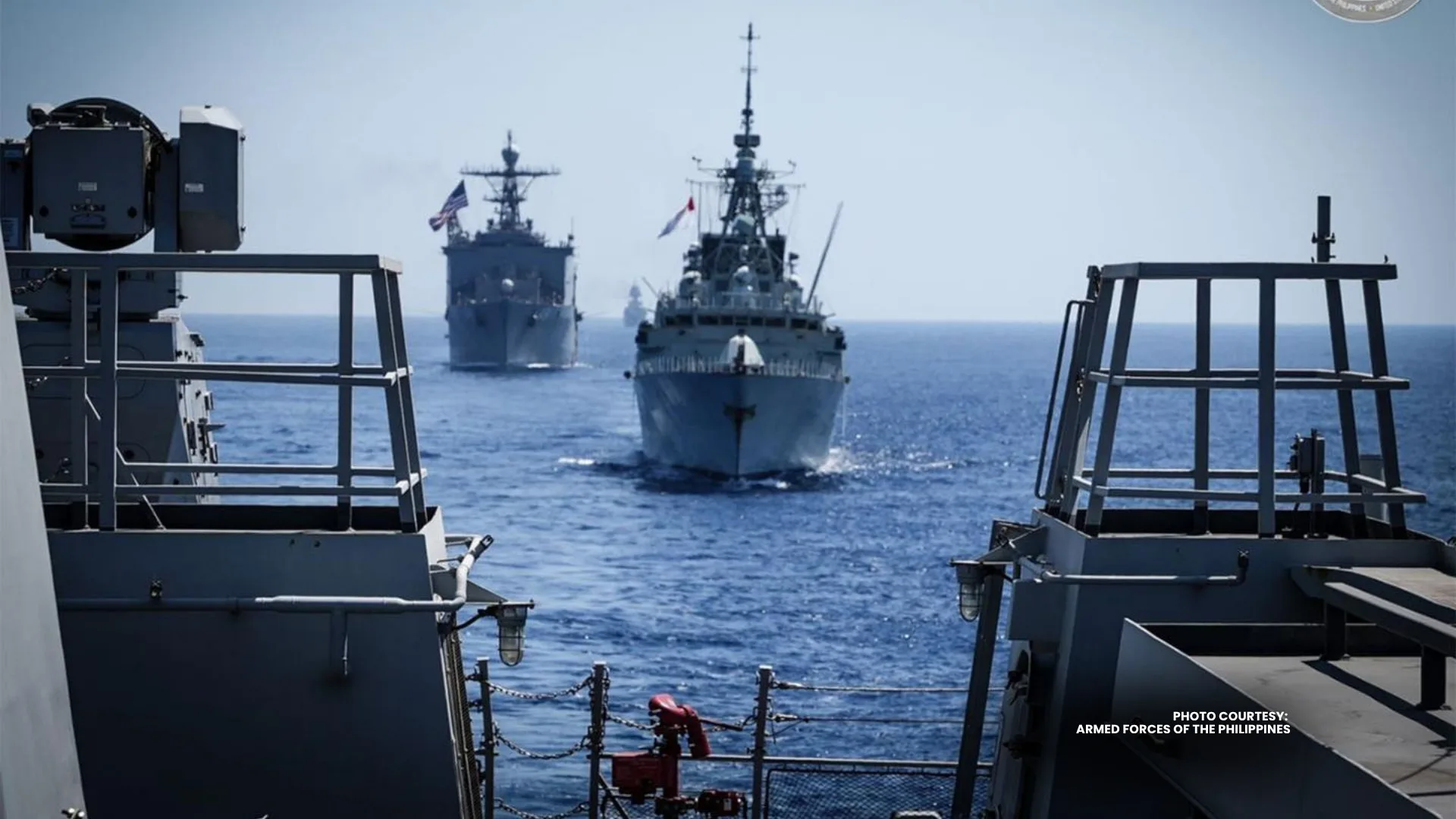
A powerful multinational flotilla consisting of 11 vessels has commenced a complex series of maritime maneuvers in the West Philippine Sea as part of the 41st iteration of Exercise Balikatan.
Bringing together the naval might of the Philippines, the United States, Japan, Australia, and Canada, the operations represent a significant escalation in the scope of the annual war games.
The Philippine Navy has deployed its most advanced guided-missile frigates, the BRP Miguel Malvar and BRP Antonio Luna, supported by specialized naval helicopters and the Coast Guard’s BRP Cape San Agustin.
This combined force is operating alongside a diverse array of international warships, including the USS Ashland and the USCGC Midgett from the US, as well as high-end destroyers and transport docks from the Japan Maritime Self-Defense Force. Australia’s HMAS Toowoomba and Canada’s HMCS Charlottetown and MV Asterix round out the fleet.
According to military officials, the exercises are designed to test the “interoperability” of these diverse forces in high-stakes scenarios.
The drills include anti-submarine warfare, live-fire gunnery, and air and missile defense. By training as a single cohesive unit, the participating nations aim to demonstrate a credible defense posture and a shared commitment to maintaining regional stability in contested waters.
“The integration of these capabilities is the cornerstone of regional peace,” a Philippine military spokesperson stated, noting that the presence of such a large multinational force serves as a visible deterrent. Beyond the naval maneuvers, the broader Balikatan 41-2026 exercise involves more than 17,000 personnel training across the archipelago in space, cyber, and land domains, marking it as the most expansive iteration in the history of the alliance.
This Multinational Maritime Event (MME) under Exercise Balikatan 41-2026 underscores the shared commitment of the Philippines with its allies and partners to strengthen cooperation and regional stability. Building on this momentum, the AFP continues to advance its capability to safeguard national sovereignty and maritime interests while upholding a rules-based international order.