
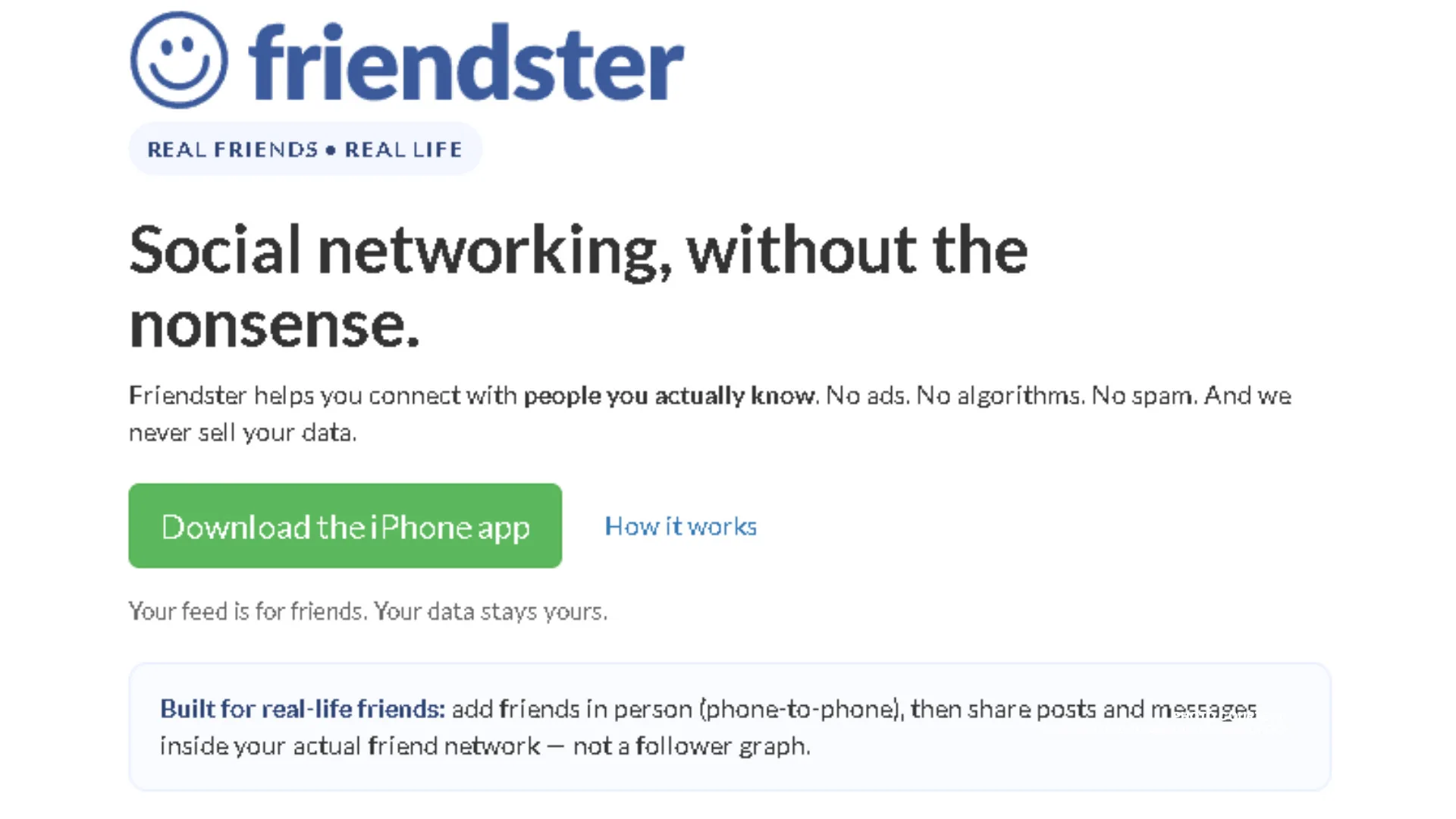
Friendster is back. And to make friends on it, you’ll have to actually meet some.
The relaunched iOS app requires users to physically tap phones together to connect, betting that the antidote to social media’s loneliness epidemic is making you do the one thing social media replaced: show up in person.
If you’re asking what Friendster is, you probably skipped an entire era of the internet. If you remember it, you likely also recall waiting several minutes for a profile to load, rearranging your Top Friends like it had real social consequences, and treating a testimonial as a public declaration of loyalty.
Launched in 2002, Friendster is widely considered one of the first modern social networks — the template that platforms like Facebook would later refine, scale, and eventually weaponize.
Before the algorithm decided what you were, you decided. You picked your song. You wrote your own “About Me” in a tiny text box like it was a college application. You customized your cursor. If you were really committed, you found a blinking GIF and made it your background. Your profile was a bedroom wall, not a brand.
At its peak, Friendster reached over 115 million users worldwide, including more than 13 million in the Philippines by 2009, helping cement the country’s reputation as the Social Media Capital of the World.
Like many early platforms, it eventually declined due to technical limitations, rising competition, and a poorly timed pivot to social gaming. The service shut down in 2015, and the company officially closed in 2018.
Thhistory is part of what makes its return notable.
Twenty-four years later, the platform has been revived under developer Mike Carson, who acquired the domain and trademarks in 2025.
The new version removes several features now standard on most platforms. It does not include advertising, algorithm-driven feeds, or public metrics designed to amplify reach. Content is limited to a user’s existing network.
Connections are also restricted. Users can only add contacts by physically tapping phones using near-field communication (NFC), limiting interaction to people who have met in person rather than through search or suggested networks.
The app is currently available on iOS, with no Android or web version announced. Details about its feed structure and broader rollout remain limited.
The result is a more contained model, focused on direct connections rather than large-scale network growth.
Whether it scales, or even aims to, remains an open question. At a time when most platforms are built for reach and constant engagement, Friendster takes a different approach, focusing on staying small, keeping connections real, and meeting people in person. Ideally, people you actually like.