
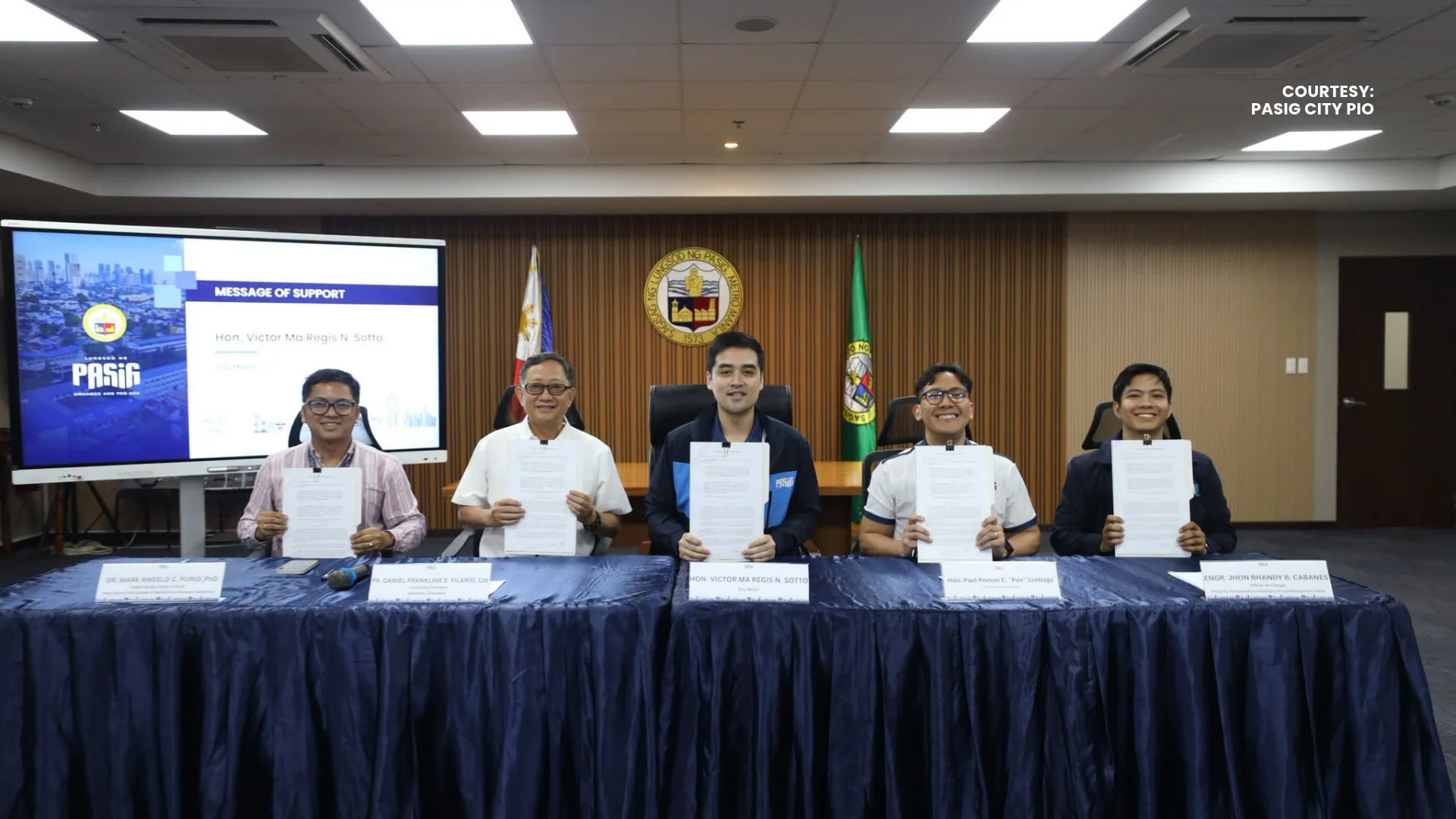
Adamson University is partnering with the Pasig City government to use satellite technology, artificial intelligence (AI), and quantum computing research to identify strategic locations for electric vehicle (EV) charging stations.
University President Fr. Daniel Franklin E. Pilario, CM, and Pasig City Mayor Vico Sotto signed a memorandum of understanding (MOU) on October 20 for the implementation of Project STArQE (Space Technology, Artificial Intelligence, and Quantum Algorithms for Electric Vehicle and Renewable Energy Optimization).
Under the agreement, Adamson will develop datasets, analytical tools, technical reports, and recommendations to help the city assess potential charging station locations and guide transportation and infrastructure policies.
The research will combine transportation, environmental, and climate data with satellite and geospatial technologies, AI, and quantum-based approaches to evaluate the suitability of proposed charging sites.
Dr. Mark Angelo C. Purio, project leader and head of Adamson’s Space Technologies & Applications Research Laboratory (STARLab), said the partnership would bring the university’s research into practical applications.
“By integrating satellite technology, artificial intelligence, and quantum computing, we aim to provide science-based tools that can help local governments make more informed decisions on sustainable transportation and urban infrastructure,” Purio said.
Pasig City’s City Transportation Development and Management Office (CTDMO) will oversee the project’s local implementation. The agreement will remain in effect until June 30, 2028, unless extended by mutual agreement.
Project STArQE is a three-year research initiative led by Adamson and funded by the Department of Science and Technology–Philippine Council for Industry, Energy, and Emerging Technology Research and Development (DOST-PCIEERD) under the Philippines-Thailand Joint Call for Proposals 2024 (IDEAL) Program.
The project is based at Adamson’s STARLab and Monitoring of Indicators for Efficient Redevelopment and Value Assessment (MINERVA) Laboratory. Its research partners are Thailand’s Suranaree University of Technology and the Quantum Computing Society of the Philippines (QCSP).
In 2025, the project was featured in the Philippine country report on the national quantum ecosystem during the 1st ASEAN Quantum Summit. ASEAN Secretary-General Dr. Kao Kim Hourn also cited the initiative as an example of research collaboration between the Philippines and Thailand.
The multidisciplinary research team includes experts in satellite remote sensing, geospatial analysis, AI, quantum algorithms, power systems, and infrastructure planning, as well as faculty members, technical personnel, and graduate students from Adamson and QCSP.
Beyond EV charging infrastructure, the partnership could pave the way for further research into intelligent transportation systems, urban climate monitoring, digital twins, and other smart city technologies.
Purio also said the team hopes to demonstrate how research conducted at Philippine universities can be translated into practical solutions that directly benefit local communities.
Also present at the signing were Adamson Vice President for Academic Affairs Dr. Rosula S.J. Reyes, College of Engineering Dean Dr. Antonio P. Doroliat, and members of the project team.
Pasig City was represented by Pao Santiago, vice chairperson of the Sangguniang Panlungsod Committee on Technology, Communication and Energy, and CTDMO officer-in-charge Jhon Rhandy Cabanes.