
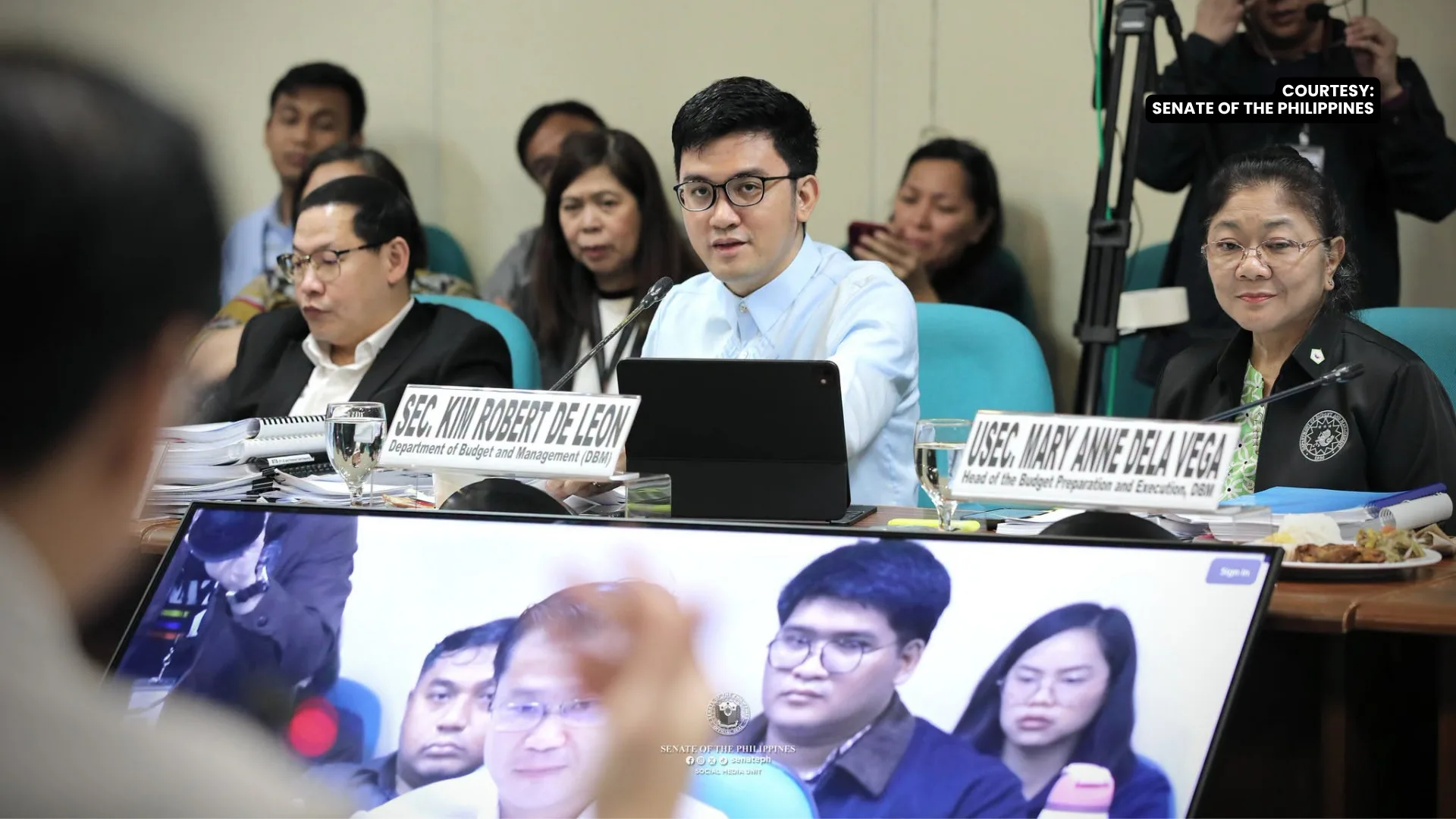
Leading by example in the responsible management of public funds, the Department of Budget and Management (DBM) has trimmed its original P5.780-billion funding request for Fiscal Year (FY) 2027 by P2.655 billion, bringing its proposed budget down to P3.125 billion without compromising essential services and priority reforms.
The P3.125-billion allocation under the proposed FY 2027 National Expenditure Program (NEP) is also P444.23 million, or 12.45 percent, lower than the department’s FY 2026 budget of P3.57 billion.
During the Senate Committee on Finance hearing on October 22, DBM Secretary Kim Robert C. De Leon underscored that the department is applying to itself the same spending discipline and prudent resource management it expects from other government agencies.
“This is a classic example of DBM practicing what it preaches,” Secretary Kim told senators.
The Budget Chief emphasized that the reduction was made possible through a careful reassessment of spending priorities, more efficient use of existing resources, and the elimination of funding requirements that could be addressed without additional appropriations.
“One thing we can assure the Chamber is that no service will be adversely affected by a lower budget allocation. We’re just spending more efficiently, revisiting whether we really need these items. And in fact, even pursuing more efficiency measures without entailing substantial costs on the part of government,” Sec. Kim assured.
Among the most significant adjustments is the DBM’s zero capital outlay allocation for FY 2027, alongside reductions in Maintenance and Other Operating Expenses (MOOE), including certain information and communications technology requirements.
Secretary Kim explained that the department has available continuing appropriations from previous years that can support eligible requirements in FY 2027, subject to applicable budgeting and accounting rules.
Rather than automatically seeking fresh appropriations, the DBM is maximizing available resources, reviewing the necessity of proposed expenditures, and prioritizing spending that directly supports the delivery of its mandate.
“Instead of asking for more, we intend to maximize on that and revisit the quality of spending,” Secretary Kim also said.
The approach underscores a fundamental principle of sound public financial management: government spending must be guided by actual needs, available resources, and measurable results, not simply by the size of an agency’s budget.
Despite its leaner proposed budget, the DBM is pressing ahead with digital reforms aimed at improving transparency, reducing paperwork, and accelerating government processes.
Among these is DBM COMPASS, or the Centralized Open Monitoring Platform for Appropriations and Spending Statistics, a digital transparency initiative launched using existing government resources at no additional cost.
The department is also rolling out DBM SUBMIT, an in-house-developed digital portal that will enable government agencies to electronically submit supporting documents for budget release requests, reducing dependence on physical submissions and manual processes.
Both initiatives demonstrate how government can pursue modernization by maximizing the capabilities of its own personnel and existing technological resources, instead of automatically requiring additional expenditures.
“This is how we intend to pursue our digital transformation, not really needing much additional spending on the part of government, but utilizing existing talents and resources that we have,” the Budget Secretary explained.
The DBM’s spending adjustments also drew recognition from Senate leaders during the budget hearing.
Senate Committee on Finance Chairperson Senator JV Ejercito acknowledged the department’s understanding of the government’s fiscal constraints, particularly as agencies compete for limited public resources.
“Kung meron mang nakakaintindi ng ating fiscal space, it’s DBM,” Senator Ejercito remarked.
Senate President Sherwin Gatchalian likewise underscored the importance of leading by example, noting that the Senate is also pursuing measures to exercise greater spending restraint.
“Practice what we preach, pareho kay Secretary,” the Senate President remarked.
By reducing unnecessary funding requirements, maximizing existing resources, and sustaining reforms without additional costs, the DBM is demonstrating that a leaner budget can go hand in hand with more efficient, transparent, and responsive public service.