
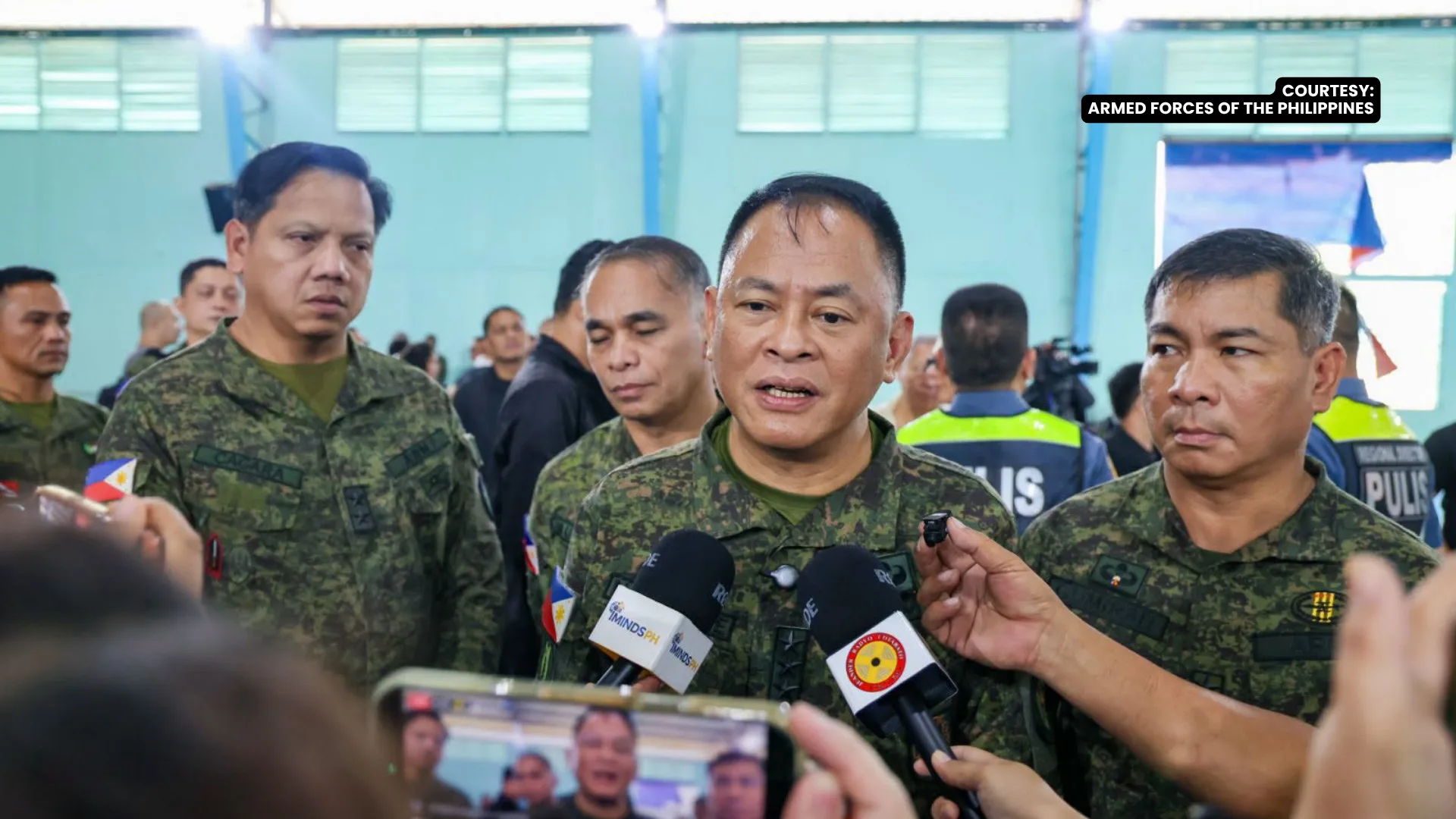
Swift coordination among established joint peace mechanisms, national law enforcement, and state armed forces emerged as a vital pillar in ensuring the peaceful, credible and orderly execution of the inaugural 2026 Bangsamoro Parliamentary Elections (BPE).
Working alongside the Commission on Elections (COMELEC), the Office of the Presidential Adviser on Peace, Reconciliation and Unity (OPAPRU) and the Government Peace Implementing Panel (GPIP) mobilized an integrated monitoring network to respond dynamically to security threats throughout the polling period.
On election day, high-ranking officials, including National Bureau of Investigation (NBI) Special Assistant for Mindanao Concerns Voltaire G. Rovira II, GPH Joint Normalization Committee Chairperson David Diciano, and GPH-Joint Peace and Security Committee Member Col. Roberto Huet (Ret.), traveled from Lanao del Sur to Cotabato City. There, they integrated operations at the OPAPRU Information Operations Coordination Center (IOCC) with Presidential Peace Adviser Sec. Mel Senen Sarmiento and NBI Regional Director-BARMM Atty. Marvin Matamis, following instructions from NBI Director Melvin Matibag.
“Our foremost obligation is to ensure that the Bangsamoro electorate can cast their ballots freely, safely, and without intimidation as part of President Ferdinand R. Marcos Jr.’s directive for peaceful, orderly, and credible elections in the Bangsamoro Autonomous Region in Muslim Mindanao,” Sec. Sarmiento emphasized.
“Credibility is forged not merely by the opening of polling centers, but by the swiftness of our response when tensions arise. It was imperative for OPAPRU to engage our principal law enforcement and defense partners: the NBI, the Armed Forces of the Philippines (AFP), and the Philippine National Police (PNP), alongside our peace mechanisms to maintain institutional trust throughout this exercise,” Secretary Sarmiento, who serves concurrently as Chairperson of the Government Peace Implementing Panel, said.
Operating as the primary intelligence hub for real-time reporting and situational analysis across the region, the IOCC linked NBI field teams directly with GPH-MILF peace structures, including the Joint Peace and Security Committee (JPSC), the Joint Coordinating Committee on the Cessation of Hostilities (CCCH) and the Ad Hoc Joint Action Group (AHJAG).
This collaborative security matrix proved instrumental in defusing localized flashpoints across the autonomous region.
In Maguindanao del Sur, an armed clash broke out on the morning of September 14 near Nabundas Elementary School in Shariff Saydona Mustapha following a suspect’s arrest. As gunfire between government troops and an unidentified armed faction persisted for nearly two hours, a joint quick-response team from the CCCH and JPSC/Joint Peace and Security Teams (JPST) leveraged direct ceasefire communications to negotiate a halt in hostilities, successfully securing the perimeter.
In Basilan, reports indicated that voters, Electoral Board teachers, and voting materials were blocked from entering polling sites in Al-Barka. OPAPRU deployed a rapid response unit alongside the 1101st Infantry Brigade, the PNP, COMELEC, local executives and MILF CCCH representatives. The joint intervention established safe passage guarantees and mobilized JPST escorts, allowing all nine polling centers in the municipality to begin operations before midday.
Preventative security measures had also been undertaken prior to election day. Following potential security risks in Lanao del Norte, Diciano, military leaders from the 2nd Mechanized Infantry Brigade, and local police held direct talks with MP Abdullah “Bravo” Macapaar, commander of the MILF-BIAF Northwestern Mindanao Front, and local front commanders in Munai to clarify movement rules and preserve regional stability.
The successful holding of the parliamentary polls marks the completion of the Political Track under the landmark Comprehensive Agreement on the Bangsamoro, formally concluding the regional government’s political transition into a directly elected parliament.