
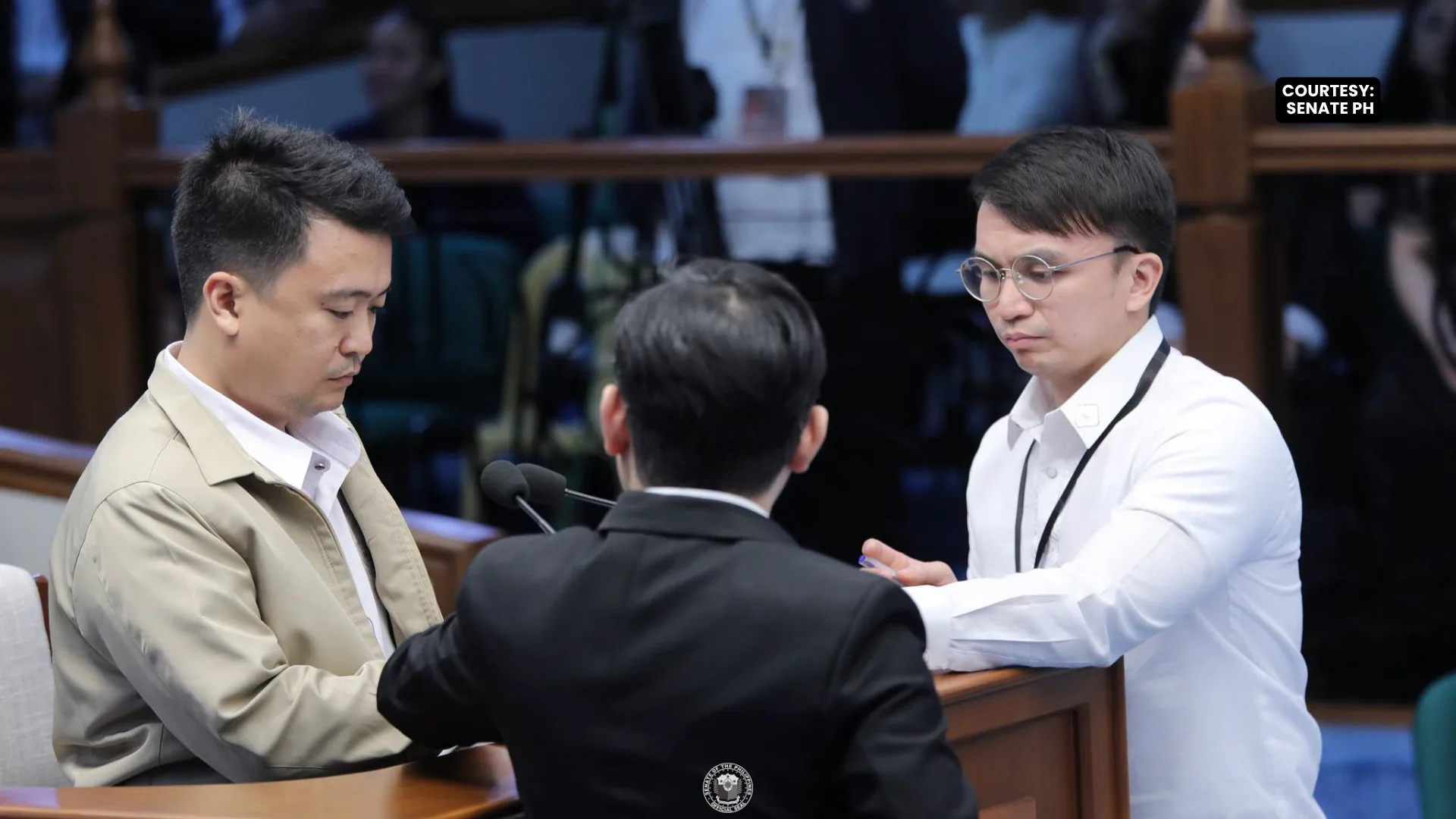
National Bureau of Investigation (NBI) Senior Agent John Mark Calilung told the Senate impeachment court that he personally considered Vice President Sara Duterte’s alleged threat against top government officials as “absolute,” even as he acknowledged that the NBI affidavit described the statement as conditional.
Calilung, the first prosecution witness under Article IV of the Articles of Impeachment involving alleged grave threats, conducted the forensic examination of the recorded video statement in which Duterte allegedly threatened to have President Ferdinand Marcos Jr., First Lady Liza Araneta-Marcos, and former Speaker Ferdinand Martin Romualdez killed through another person.
The exchange took place on the third day of Duterte’s impeachment trial, during the continuation of Calilung’s testimony.
Senator-judge Alan Peter Cayetano questioned Calilung on how he assessed Duterte’s statement, particularly the phrase “kapag pinatay ako,” and whether it made the alleged threat conditional.
Calilung said the condition was taken into account, but added that the alleged prior conversation with another person was a key factor in the investigation.
“First of all po doon sa statement, may nakausap na po, it already took place before pa ‘yung mangyari ‘yung meeting,” Calilung said.
Pressed further on the phrase “pag pinatay ako,” Calilung said the statement created a condition but also raised the possibility that a third party could act on it.
“There is a condition na kapag pinatay siya, but as we can see, it’s only applicable if there is only two parties,” Calilung said.
“The statement make a loophole wherein a third party can use that kapag namatay si VP, ma-e-execute niya yung statement ni VP na may nakausap na siya,” he added.
Cayetano then asked whether the NBI reports treated the statement as a conditional threat.
“Based on our affidavit, sir, I believe it’s conditional,” Calilung said.
Cayetano followed up by asking Calilung for his personal assessment as an investigator.
“Based on your affidavit, conditional. But your initial assessment, your personal as an investigator?” Cayetano asked.
Calilung replied: “The threat is absolute, sir.”
Earlier, defense counsel Carlo Joaquin Narvasa questioned Calilung on the NBI affidavit of investigation, the Department of Justice’s earlier case build-up certification, and whether Marcos, Araneta-Marcos, and Romualdez personally appeared before the NBI or filed criminal complaints.
Calilung said the three did not appear before the bureau and that he had no personal knowledge of whether they filed complaints.
Under questioning from Sen. Erwin Tulfo, however, Calilung said the NBI may proceed with investigations involving threats against top officials even without a complaint if the evidence is sufficient.
“Ang basis namin doon, Your Honor, is ‘yung primary objective namin to investigate cases to the threat to the President, Vice President, Senate President, Supreme Court, and if we found that the evidence is enough, that there is a crime committed, we will file a case because that’s the output of our investigation, sir,” Calilung said.
Asked whether the NBI could act without a complaint from the alleged victim, Calilung answered: “We submitted it, sir, even without a complaint in the preliminary investigation, sir.”
Calilung also told Cayetano that the investigation began after he received a call from his executive officer about Duterte’s video statement.
“It all started, I received a phone call, sir, from my executive officer that there is a video wherein there is a statement given by the vice president which is classified as threat and I was tasked and assigned to investigate the case, sir,” he said.
He said the NBI also sought to look into the alleged threat to Duterte’s life by inviting her to appear before the bureau.
“It is included in our letter to the vice president, Your Honor. That’s why we’re inviting her to proceed to our office to investigate the threats to her life,” Calilung said.
The third day of the trial also covered Calilung’s qualifications, his work in video authentication, and the NBI’s authority to investigate threats against top government officials.
Calilung told the court he is a Certified Public Accountant with training in computer hacking forensic investigation, computer forensics, mobile forensics, photo and video authentication, cybercrime investigation, and 480 hours of cybersecurity training.
Sen. Joel Villanueva asked how investigators assess threats. Calilung said they consider whether the threat is active and whether the person who made it has the capability to carry it out.
“If it’s an active threat, if the one giving the threat is capable of doing so,” Calilung said.
He added that investigators also look at “official capability or power” and the manner in which the threat was delivered.
“Not only, sir, but also how it was delivered, sir,” Calilung said.
The prosecution said Calilung’s testimony reinforced the gravity of Article IV, noting that the NBI investigator stood by his personal assessment that the alleged threat was absolute despite cross-examination and clarificatory questions from senator-judges.