
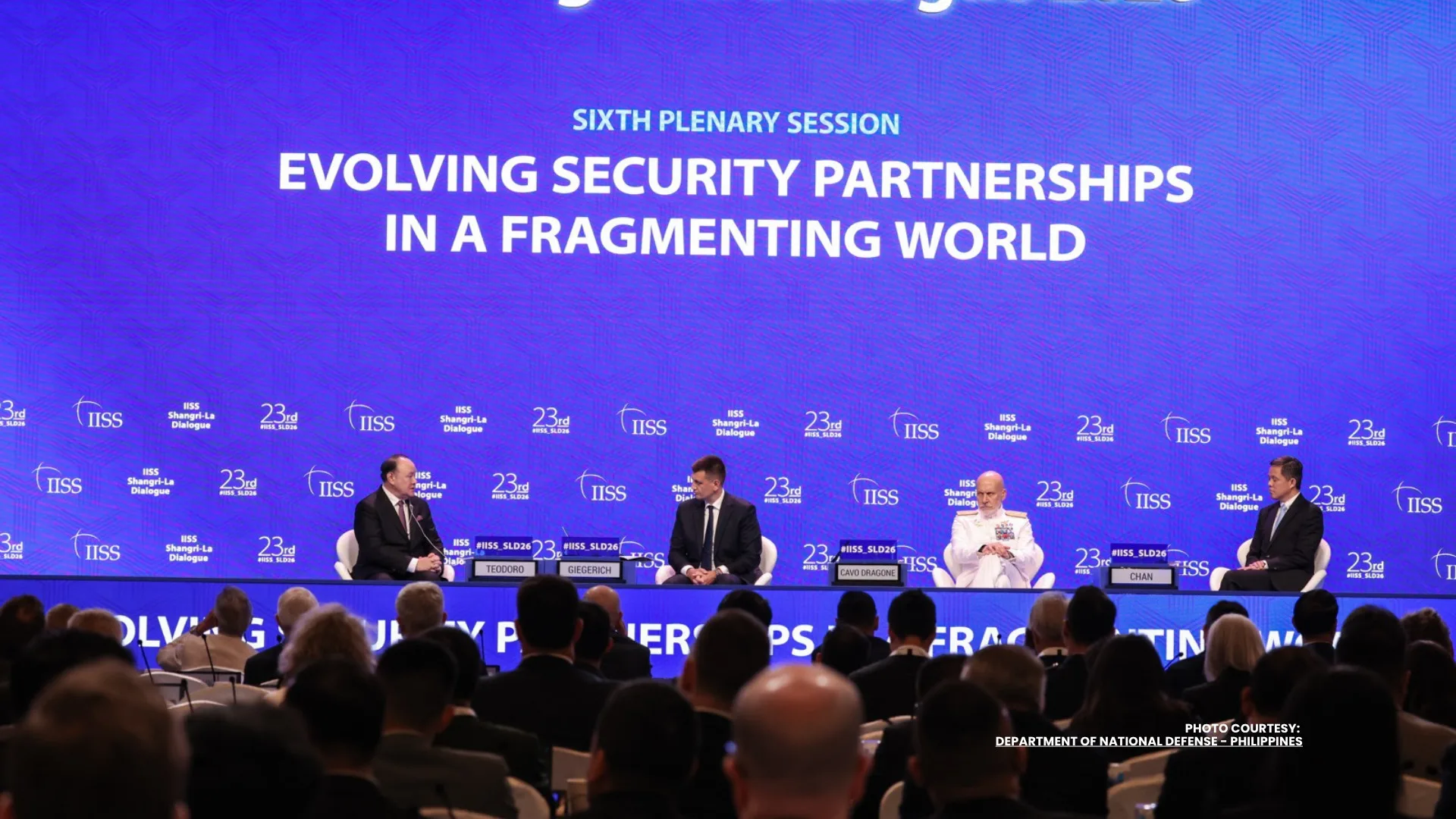
Defense Secretary Gilberto Teodoro Jr. on Sunday called for stronger convergence among like-minded countries as he presented a vision of the Philippines as an “Archipelagic Sentinel” and “Guardian of the Freedom of the Seas.”
Teodoro made the statement during the sixth plenary session on “Evolving Security Partnerships in a Fragmenting World” at the International Institute for Strategic Studies Shangri-La Dialogue in Singapore on May 31.
Speaking ahead of the 10th anniversary of the arbitral award on the South China Sea, Teodoro underscored the Philippines’ role as a hub for countries committed to upholding international law, particularly the 1982 United Nations Convention on the Law of the Sea.
“Our allies and partners, some with differences among themselves, have nonetheless found common ground in our waters,” Teodoro said.
Building on this, Teodoro introduced the vision of the Philippines as an “Archipelagic Sentinel” and a “Guardian of the Freedom of the Seas,” a concept developed by Filipino maritime law expert Professor Jay Batongbacal.
Teodoro said the country’s geography places it in a strategic position to help protect maritime freedom.
“The Philippines is well-placed to safeguard maritime liberty and the legal and physical infrastructure that enables the world to sail, to trade, and to prosper,” he said.
Guided by this vision, Teodoro said the Philippines remains committed to four principles: sovereignty and territorial integrity, the international rule of law, ASEAN centrality, and deterrence.
“As Archipelagic Sentinel, we will stand watch over our sovereign rights and entitlements, and as a Guardian of the Freedom of the Seas, we will stand watch with the international community in our part of the world,” he said.
Amid ongoing conflicts overseas, Teodoro also renewed his call at the Paris Defense and Strategy Forum in March for stronger international convergence to protect innocent civilians.
He said the international order must give special concern to migrant workers from the Philippines and other Asian countries, citing their role in the global economy and in the countries and sea lanes they serve.
“The international order should have a special concern and obligation to protect migrant workers from the Philippines… and other Asian countries… not only because their rights and dignity must be upheld as a fundamental obligation of humankind, but also because their very services and sacrifice underpin the global economy and quality of life of the countries they serve and on the sea lanes they ply,” Teodoro said.