
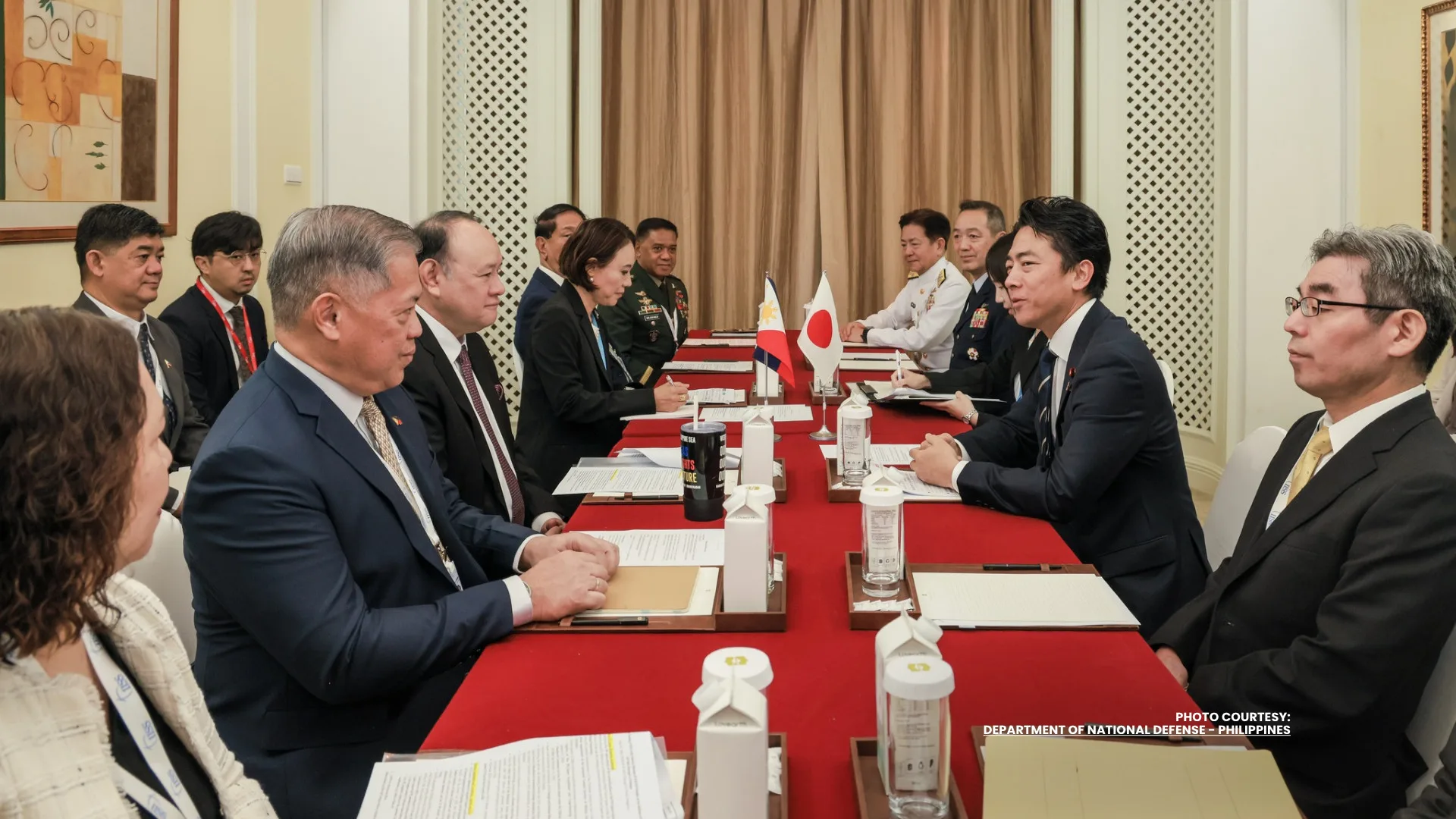
Defense Secretary Gilberto Teodoro Jr. said the Philippines and Japan are deepening defense cooperation as both countries confront common maritime security challenges, particularly threats to their sovereignty and territorial integrity.
Teodoro said the Philippines and Japan sit along what is often called the “first island chain,” with both countries facing the Pacific Ocean and having maritime boundaries affected by China’s actions.
For Manila, he said closer cooperation with Tokyo has become an important point of convergence in building deterrence, improving defense coordination, and supporting broader economic, social, and cultural ties under a stable regional framework.
Teodoro said the Philippines’ expanding defense partnerships have been made possible by the country’s firm reliance on international law, transparency, and credibility.
He noted that such partnerships have drawn objections mainly from China, even as he stressed that Manila’s position in the West Philippine Sea is anchored on legal principles, including the United Nations Convention on the Law of the Sea (UNCLOS) and the 2016 arbitral ruling.
On the proposed ASEAN-China Code of Conduct in the South China Sea, Teodoro questioned why such an agreement remains necessary when existing international norms already govern maritime conduct.
He said the problem does not lie with ASEAN claimant states, but with China, which has continued to assert claims and take actions that smaller nations reject.
Teodoro said the Philippines will not compromise its sovereignty and territorial integrity, as doing so would violate the Constitution and the mandate given by the Filipino people to their leaders.
He also rejected suggestions that ASEAN claimant states are responsible for rising tensions at sea.
“It is not the Philippines or Indonesia or Malaysia or Brunei or Vietnam, for that matter, which is the cause of encounters at sea,” Teodoro said, pointing instead to China’s actions in disputed waters.